Summer Programme 2024
Overview: This year’s summer programme is spread across two locations: the A+E project space/Chapter House and the main body of the Cathedral. In the A+E project space we have work by Sarah Gittins and Jonathan Baxter exploring the concept of a Regenerative Cathedral. In the main body of the Cathedral we have two installations by Jenny Pope, one responding to the Frosterly Marble used at the High Altar and the other showing documentation of Jenny’s project Buoyancy In Unprecedented Times. To accompany the exhibition we also have three workshops and two artist talks. Further details and links below. (Including Eventbrite links.)
A Cathedral Tentacular
Drawings for a Regenerative Cathedral
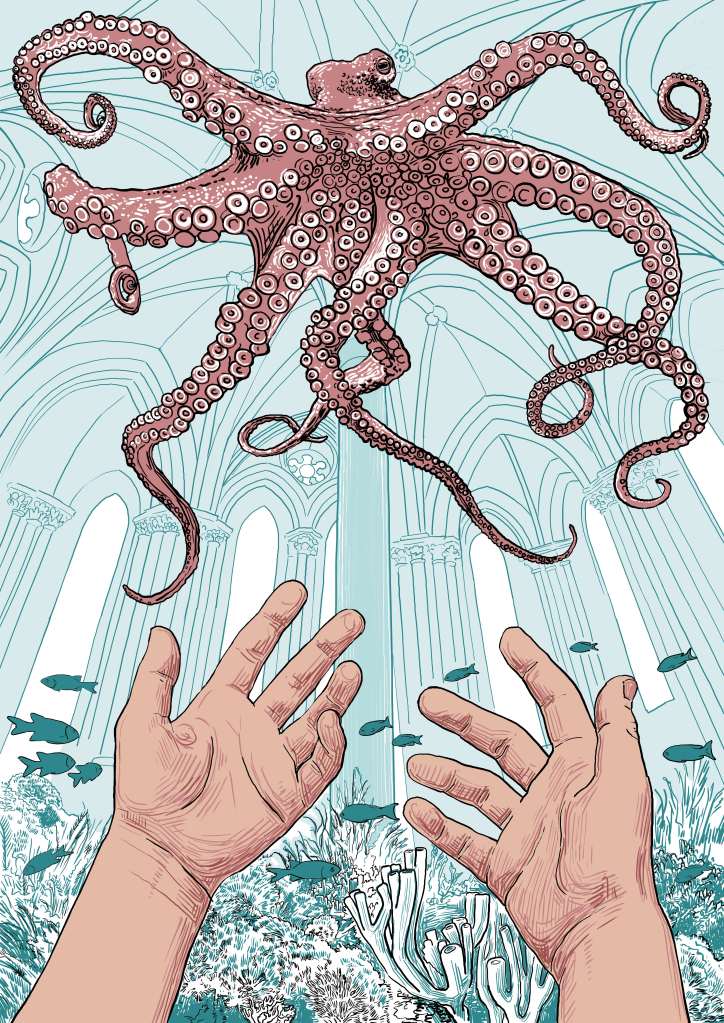
A collaboration between Sarah Gittins (digital prints and wall-drawings) and Jonathan Baxter (concept and co-design)
Where: A+E Project Space, the Chapter House, St Mary’s Episcopal Cathedral, Edinburgh – access via Manor Place
When: 3rd to 31st August, Tuesday to Saturday, 10am-5pm (closed for lunch 1-1.50pm), Sunday, 12-5pm
What: Digital prints, wall drawings and a reading room. The exhibition takes inspiration from two sources. 1. Donna Haraway’s understanding of tentacular thinking and 2. the Cathedral’s desire to become a Regenerative Cathedral.
1:
The word tentacle comes from the Latin tentare and means to try and irritate. In zoology, tentacles refer to the tentacles of cnidarians (jellyfish) or cephalopods (octopuses). Donna Haraway uses the term tentacular thinking as a counter-term and critique of a visually dominated, anthropomorphic form of thinking. The world, on the other hand, is to be perceived by touching, feeling and trying things out. The tentacles stand for the other, the non-human and implicitly pose the question of how a perception that is not two-armed, two-eyed, two-eared and one-brained, but many-armed and many-brained can generate other forms of knowledge. This also addresses the theory of ‘situated knowledge’ formulated by Haraway. Every cognition takes place from a specific position and perspective, and this positionality always requires critical reflection.
https://mosayebi.arch.ethz.ch/en/thesaurus/tentacular-thinking/
2:
[R]egenerative culture is a culture that is consciously building the capacity of everybody in a particular place to respond and change and accepts transformation as something that life just “does”. [W]e need to get away from this idea that we can plan a sustainable future on a drawing board, then implement it, and then everything will be fine forever after. It’s a journey — we will never arrive. On that journey, we just have to keep asking the right questions and keep adapting our solutions and answers. So it’s not that solutions and answers are not important, but the questions are primary and all our solutions and answers should be implemented understanding that throughout human history, the solutions of the past have become the problems of today. So why would we think that our solutions now could possibly not create problems in the future?
https://www.resilience.org/stories/2021-03-22/what-are-regenerative-cultures/
Entangling these ideas through a series of drawings (7 in this exhibition with more on the way) we ask what a Regenerative Cathedral might look like, taste like, feel like, smell like, sound like, and move like if it adopted a tentacular-regenerative response to the climate and ecological crisis? Specifically we ask:
How can this place support multispecies flourishing? How can the Cathedral respond to the triple crises of climate change, species loss and wider environmental collapse? In what small but significant ways can the Cathedral be a beacon through difficult times to address contemporary environmental and social injustices?
Some of the images show ways that the Cathedral community and the A+E project have already undertaken action to support human and more-than-human flourishing and some images envision additional becoming-more-imaginative forms of mitigation and adaptation in response to the climate and ecological crisis.
In addition to the drawings the exhibition includes a small ‘reading room’. Here you’ll find some of the tentacular-regenerative reading material that informs A+E’s engagement at the Cathedral, alongside a selection of eco-theological and Christian animist texts that challenge normative readings of Christianity as necessarily anti-ecological, colonial and patriarchal in form.
A pdf of the exhibition guide with descriptions of each digital print can be found here:
Crisisium humanitarus
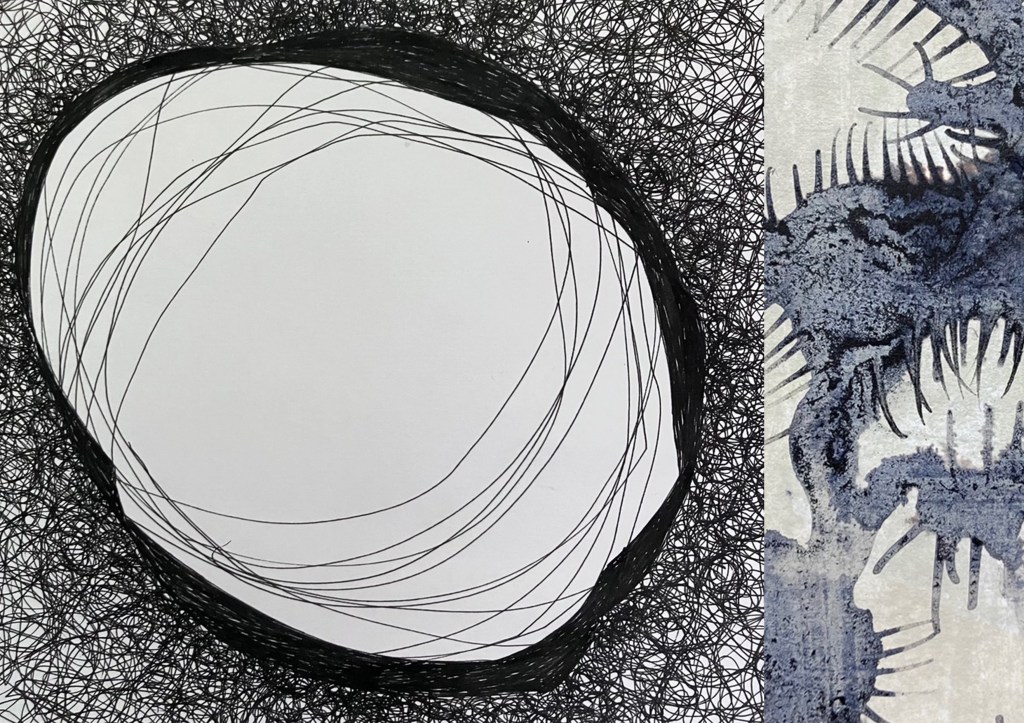
An installation by Jenny Pope
Where: High Altar, St Mary’s Episcopal Cathedral, Edinburgh
When: 1st to 31st August, Mon to Saturday, 8am-5pm, Sunday, 12-5pm
What: Jenny Pope has been inspired by the marine fossils in the Cathedral’s Frosterly Marble altar, containing now extinct animal shells and corals which grew 1 surface line daily; a clock preserved in deep time.
In response, Jenny has located contemporary ‘fossils’ made of waste plastic sheets, sewn together using dressmaking shapes, referencing our clothes as outer layers, forming human scale cocoons, shelters or containers. For Jenny the making process is important. She has used sewing, which she finds meditative and therapeutic, to create a sense of protection against the uncertainties ahead.
By siting this work at the Cathedral’s high altar, Jenny asks us to examine the wounds of environmental exploitation and extraction and to consider the part we play in this. By contrasting deep time with the immeasurably short time we now have ahead to act responsibly, Jenny is posing questions about our resilience to act and our communal moral distress as we witness changes unfolding.
Buoyancy In Unprecedented Times
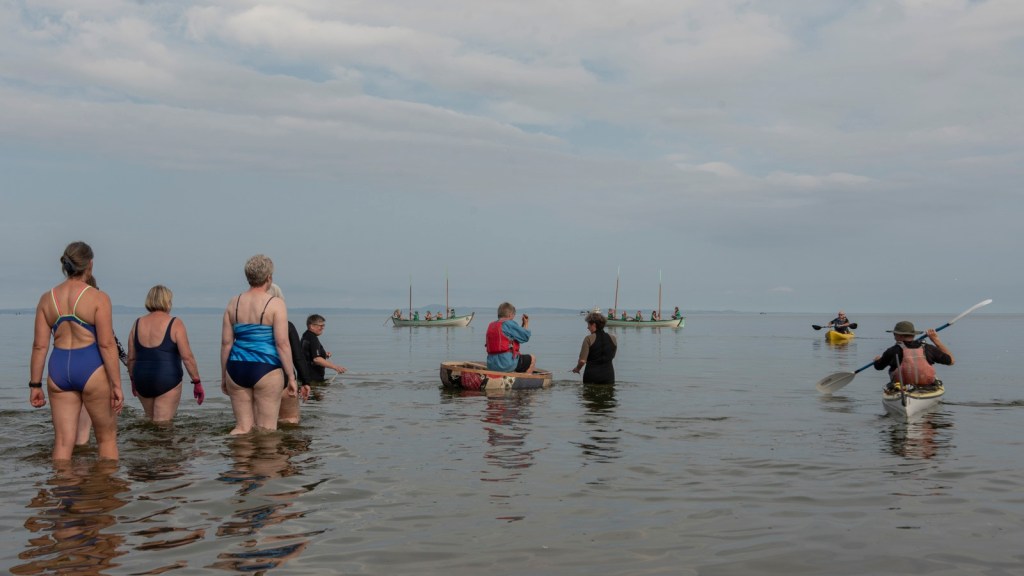
An installation by Jenny Pope
Where: King Charles Chapel, St Mary’s Episcopal Cathedral, Edinburgh
When: 1st to 31st August, Mon to Saturday, 8am-5pm, Sunday, 12-5pm
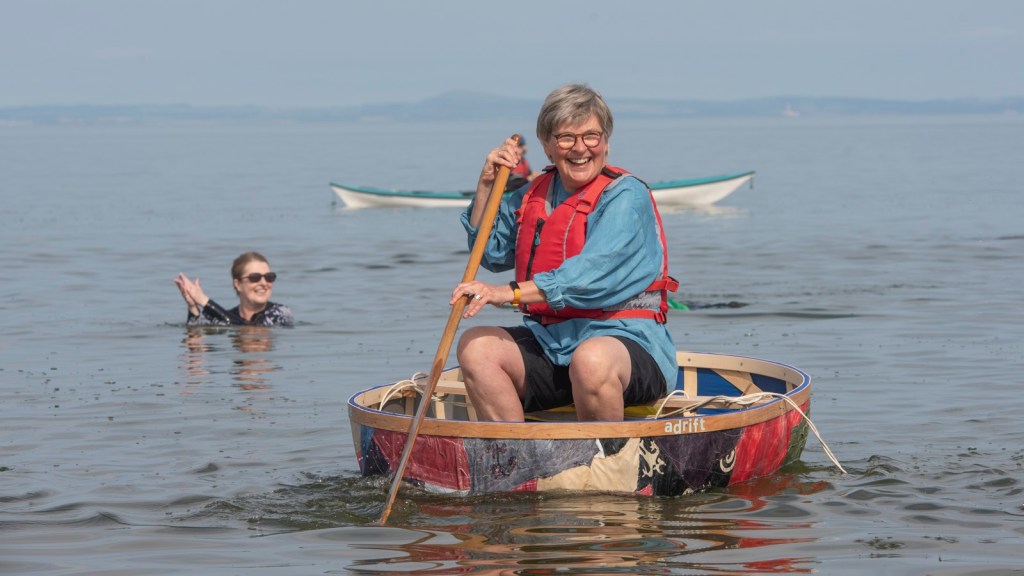
What: Jenny Pope connects early innovations in maritime travel with today’s climate crisis in order to address questions of collective anxiety and resilience. The focal point is a hand-built ‘lifeboat’, a sculptural object influenced by coracles – small, rounded vessels used for millennia in Scotland, Wales and Ireland as well as in India, Iraq, Tibet and Vietnam.
Made from bent plywood strips and lined with clothing donated by local Portobello residents, the vessel evokes the possibility of navigating hope in uncertain times. The work encourages conversations around the climate emergency and coastal communities’ complex connections with the sea.
Following a series of workshops, in which participants created a common ‘survival kit’, the art project for which the ‘life-boat’ was made culminated with a watery celebration event, launching the vessel with swimmers, rowers, singing and poetry.
This art project was part of the Creative Scotland funded Vessel Residency for Art Walk Porty 2023 and the film was commissioned by Art Walk Projects and made by Rachel McBrinn.
Events
Drawings for a Regenerative Cathedral
Artists’ Talk and Introduction
With Jonathan Baxter and Sarah Gittins
When: 4th August, 12-1pm
Where: A+E Project Space, the Chapter House, St Mary’s Episcopal Cathedral – access via Manor Place
FREE – limited spaces, book here

What: Join Jonathan Baxter and Sarah Gittins for this relaxed introduction to the A Cathedral Tentacular exhibition. The artists will introduce the exhibition, focussing their attention on the concept of a Regenerative Cathedral. They’ll share more about the making process and invite further thinking to generate future images and actions for the Cathedral to inhabit.
This is an opportunity for the Cathedral congregation, local residents and other interested parties to think more about the Cathedral’s role in a changing world, with a particular focus on creative responses to the climate and ecological crisis.
All ages welcome.
Resilience in uncertain times
A making workshop with Jenny Pope
When: 8th August, 10am-12pm
Where: A+E Project Space, the Chapter House, St Mary’s Episcopal Cathedral – access via Manor Place
Booking required, with a recommended donation of £3-£6 depending on your earnings. See here. Subsidised places available on request.
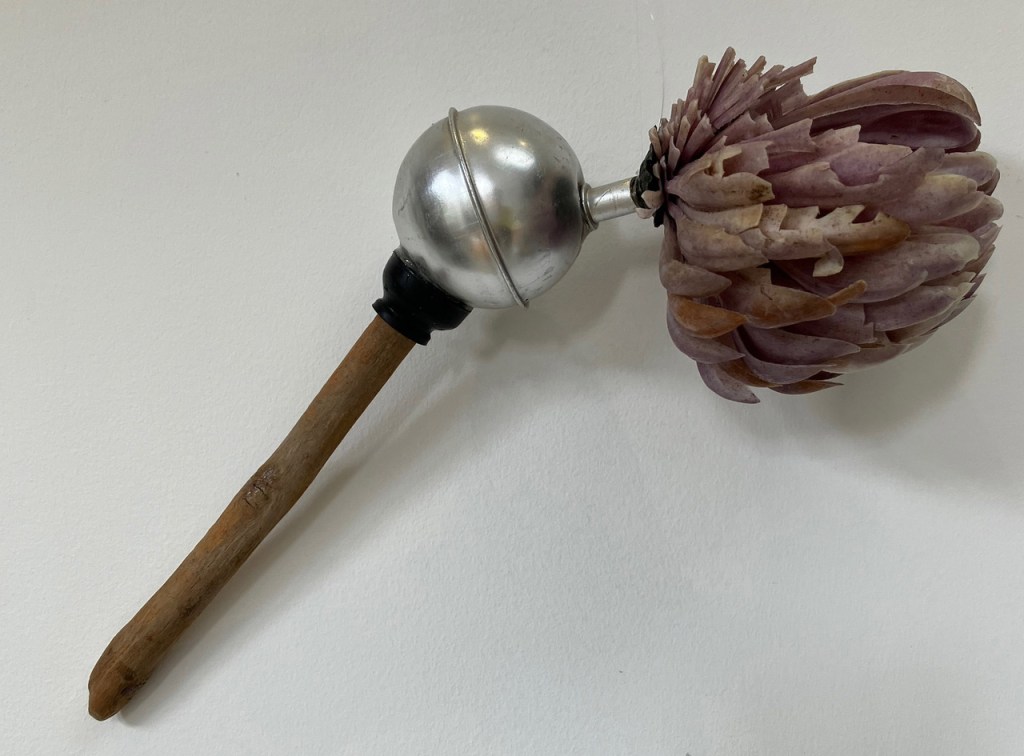
What: Responding to Jenny’s Crisisium humanitarus installation as part of the A+E summer programme, this workshop offers a space for talking and making together. It will run for one and a half hours, followed by a chance for a cup of tea and chat afterwards.
We will gather together to discuss our strategies for wellbeing in the current climate crisis and the uncertainties ahead. Thinking about what we will need to maintain our resilience, individually in these uncertain times, we will ask: what do we need? what tool/object would symbolise our own way to cope and find strength? In response to these questions each person will make a tool, or construct an object.
No need to bring anything, just turn up prepared to chat and make. Everyone over 16 years old welcome, no prior ‘artist skills’ required.
Artist Talk
with Jenny Pope
When: 9th August, 2.30-3.30/4pm
Where: Meeting at the High Altar, St Mary’s Episcopal Cathedral, Palmerston Place
Booking required, with a recommended donation of £3-£6 depending on your earnings. See here. Subsidised places available on request.
What: A chance to find out more about Jenny’s Crisisium humanitarus installation at the High Altar. We will walk around the space and Jenny will explain her ideas behind the artwork and processes involved in making it. There will be time for questions and comments. We will then have an informal chat over a cup of tea or coffee.
All ages welcome. Accompanied children can attend for free.
Wishes for Water
Celebrating the Cycles of Water and Life
A creative workshop with Dr Kate Adams
When: 14th August, 2-5pm
Where: Song School, St Mary’s Episcopal Cathedral – access via Manor Place
Booking required, with a recommended donation of £3-£6 depending on your earnings. See here for the Eventbrite link. Subsidised places available on request.
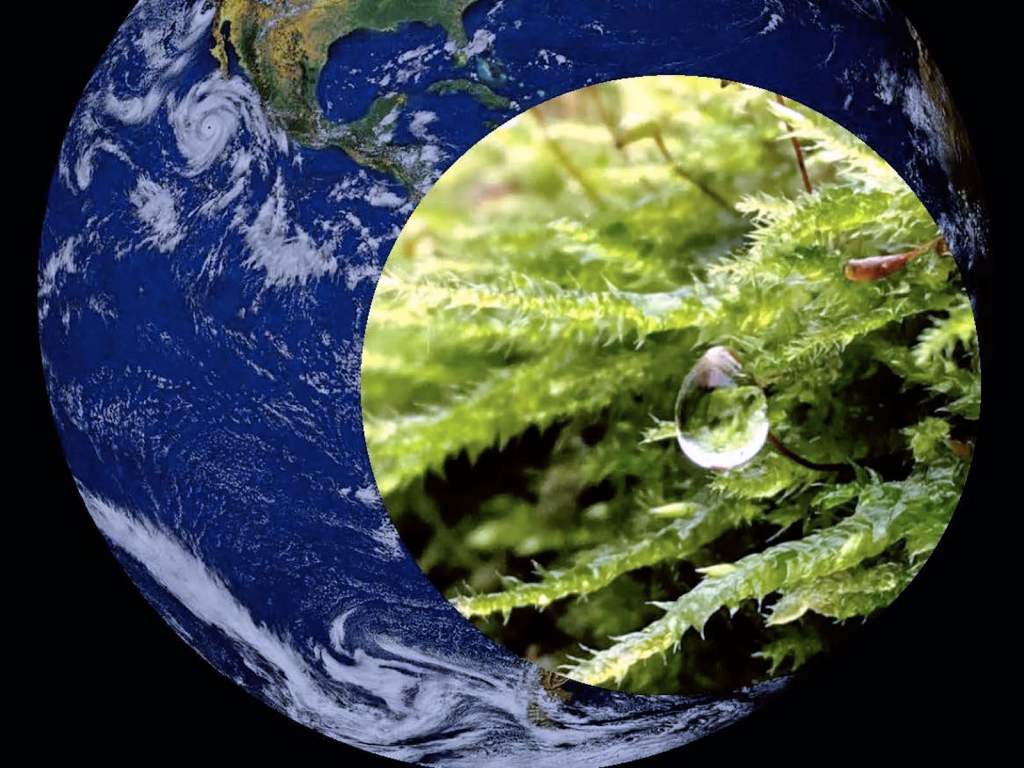
What: Water molecules make amazing journeys through oceans, rain, rivers, atmospheric rivers, glacial motion, through living beings themselves. We are all part of nature, so how does this extraordinary molecule play a part in our lives? In our experience of the sacred or of the natural world? What do we ask of water?
Join Kate Adams for a creative workshop celebrating water, nature, circulations and the cyclical. We’ll be exploring our relationship with water through movement influenced by qi gong, playful exercises, drawing and words. You do not need any prior experience to participate. This is a welcoming space for personal and creative exploration, accessible to all.
This is a two-hour workshop, followed by an informal discussion and a cup of tea for those who’d like to stay on at the end. Please let A+E know if you have any accessibility needs. Weather permitting part of the workshop will take place outdoors in the Cathedral gardens.
About Kate Adams
Kate is a facilitator, performance maker and researcher. She is a member of the Climate Psychology Alliance and runs climate cafes, talks and workshops as well as teaching and making performance. She is interested in how we can gather to share and develop creative, emotional and reflective expression in challenging times, and how we can strengthen our relationship with the natural world.
Website: www.waterisattractedtowater.com / www.kateadams.space
In Our Hands
A drawing workshop with Sarah Gittins
When: 22nd August, 10am-1pm
Where: A+E Project Space, the Chapter House, St Mary’s Episcopal Cathedral – access via Manor Place
Booking required, with a recommended donation of £3-£6 depending on your earnings. See here for the Eventbrite link. Subsidised places available on request.
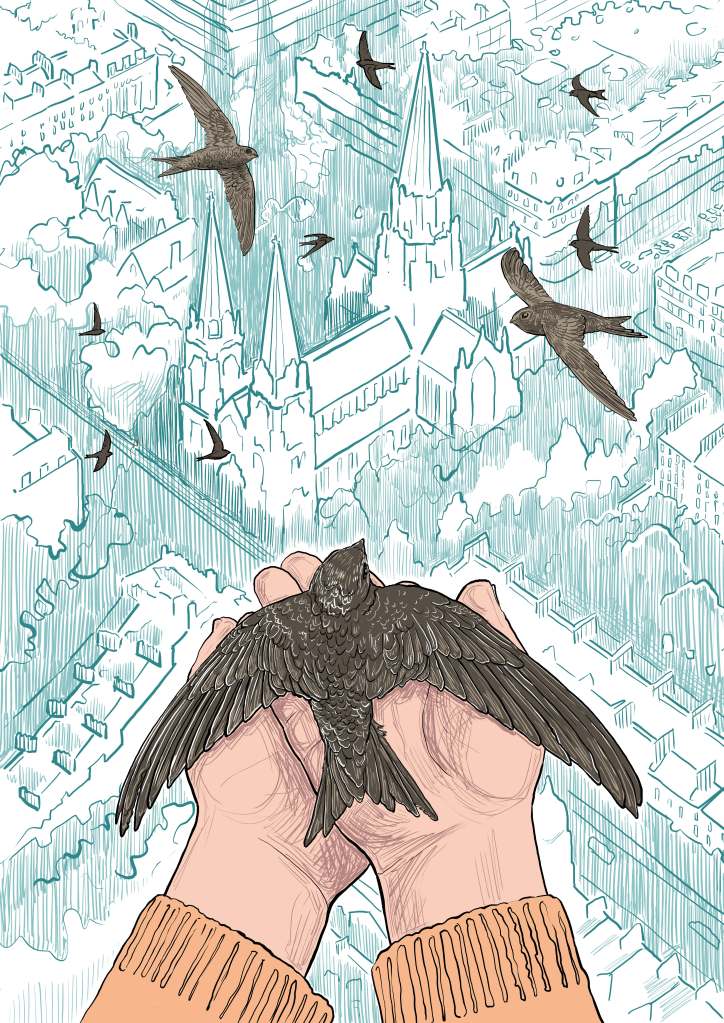
What: In the Drawings for a Regenerative Cathedral, installed in the A+E Project Space/Chapter House, hands play an important role. In each drawing hands are the main players – expressing relationships, acting as agents for change, noticing and holding up subjects of wonder and concern.
In this workshop we will take a closer look at our own and each other’s hands and consider their roles in sustaining life. The gestural forms of our hands at rest and in action will be explored through a series of enjoyable and accessible expressive drawing exercises. We will conclude with time for individual reflection and group discussion around what this process of engagement reveals.
All materials provided.
Climate Cafe Listening Circle
With Climate Psychology Alliance Scotland
When: 29th August, 2-3.30pm
Where: A+E Project Space, the Chapter House, St Mary’s Episcopal Cathedral – access via Manor Place
FREE – limited spaces, book here
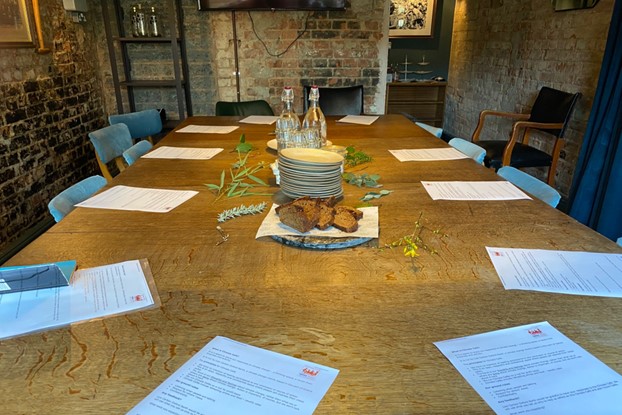
What: A climate café listening circle is a simple, hospitable, empathetic space where fears and uncertainties about our climate and ecological crisis can be safely expressed.
Why do we need climate listening circles?
As it becomes more evident that the climate and ecological breakdown are a clear and present danger to our safety and wellbeing, we increasingly need to talk about what our changing world means for us in terms of impacts at personal, family and societal level. To have these practical conversations many of us need first to be supported in exploring some complex feelings and thoughts which may often be taboo and hard to talk about.
With sturdy enough support structures in place, most people can sustain challenging feelings without either dissociating and numbing or going into blind panic. They can engage with difficult truths whilst staying connected and grounded.
A climate café listening circle aims to be such a structure – a container that is strong enough to allow the exploration of fear, anxiety, and other emotions such as anger, helplessness, sadness, grief or depression.
We use the word ‘cafe’ to evoke the simple friendliness and warmth that happens when humans share food and drink together.
In this friendly setting, the circle:
- focuses on feelings rather than action
- is not a space for discussing or debating climate policy, climate science or climate action.
The design of our climate cafe listening circles owes a lot to the pioneering work of Jon Underwood and Sue Barsky Reid, who set up the Death Cafe movement based on the ideas of Bernard Crettaz. We have adapted and developed their model drawing on our deep experience of climate psychology.
What happens during a climate listening circle?
The focus of discussion is participants’ thoughts and feelings about the climate and ecological crisis. There are no guest speakers and no talks, and it is an advice-free zone. Whilst the climate and ecological crisis is usually the main focus of the circle, we realise that other related preoccupations – personal, social or political – need a space to be explored. This can happen here too.
Our circles are open to anyone aged 18 or over who is worried about the climate and ecological crisis.
 A+E
A+E 